
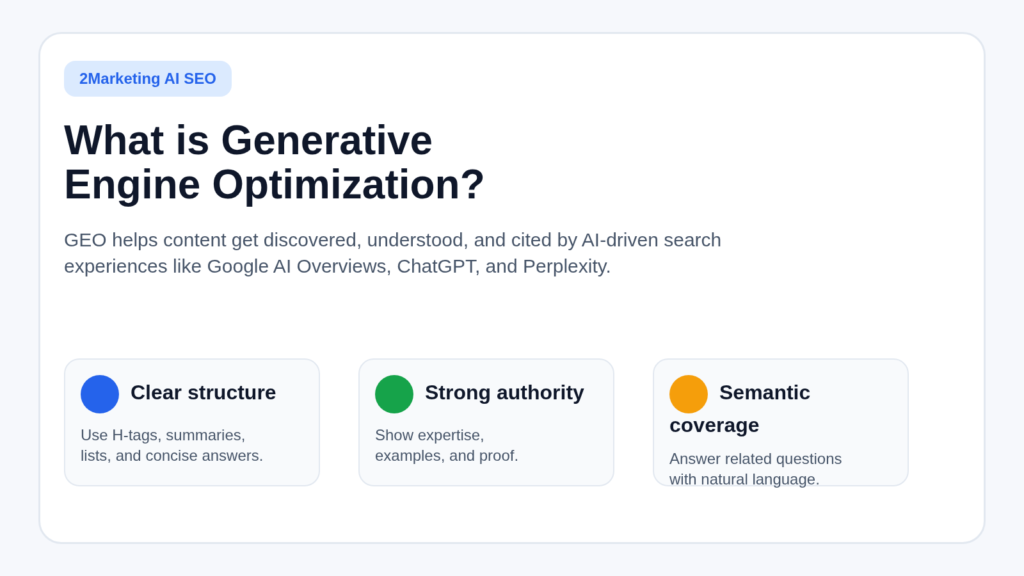
Generative Engine Optimization (GEO) is the practice of structuring and optimizing website content so it can be easily discovered, interpreted, and cited by AI-powered search engines like ChatGPT, Perplexity, and Google AI Overviews. In plain English, it is about making your content useful enough, clear enough, and trustworthy enough that an AI system can pull from it with confidence.
That is the broad definition. But the more practical version, I think, is this: GEO is what happens when content stops chasing only rankings and starts earning inclusion in answers. That shift matters. A lot. Search is no longer just a list of links. Increasingly, people ask a question and expect a synthesized response. If your site helps shape that response, your visibility grows in a different, arguably more durable, way.
Traditional SEO still matters. It absolutely does. Yet GEO changes the emphasis. Instead of obsessing over keyword density or writing pages that sound like they were arranged by a machine for another machine, the smarter move is to publish content that answers real questions well, covers the topic with depth, uses clean structure, and demonstrates actual authority. Lists help. Tables help. Definitions help. First-hand examples help even more.
In this guide, we will break down what Generative Engine Optimization is, how it differs from traditional SEO, why it matters for brands in 2026 and beyond, and how to create pages that are easier for both humans and AI systems to trust. We will also cover practical GEO tactics, common mistakes, useful schema, internal linking, content formats, and a realistic workflow you can use today.
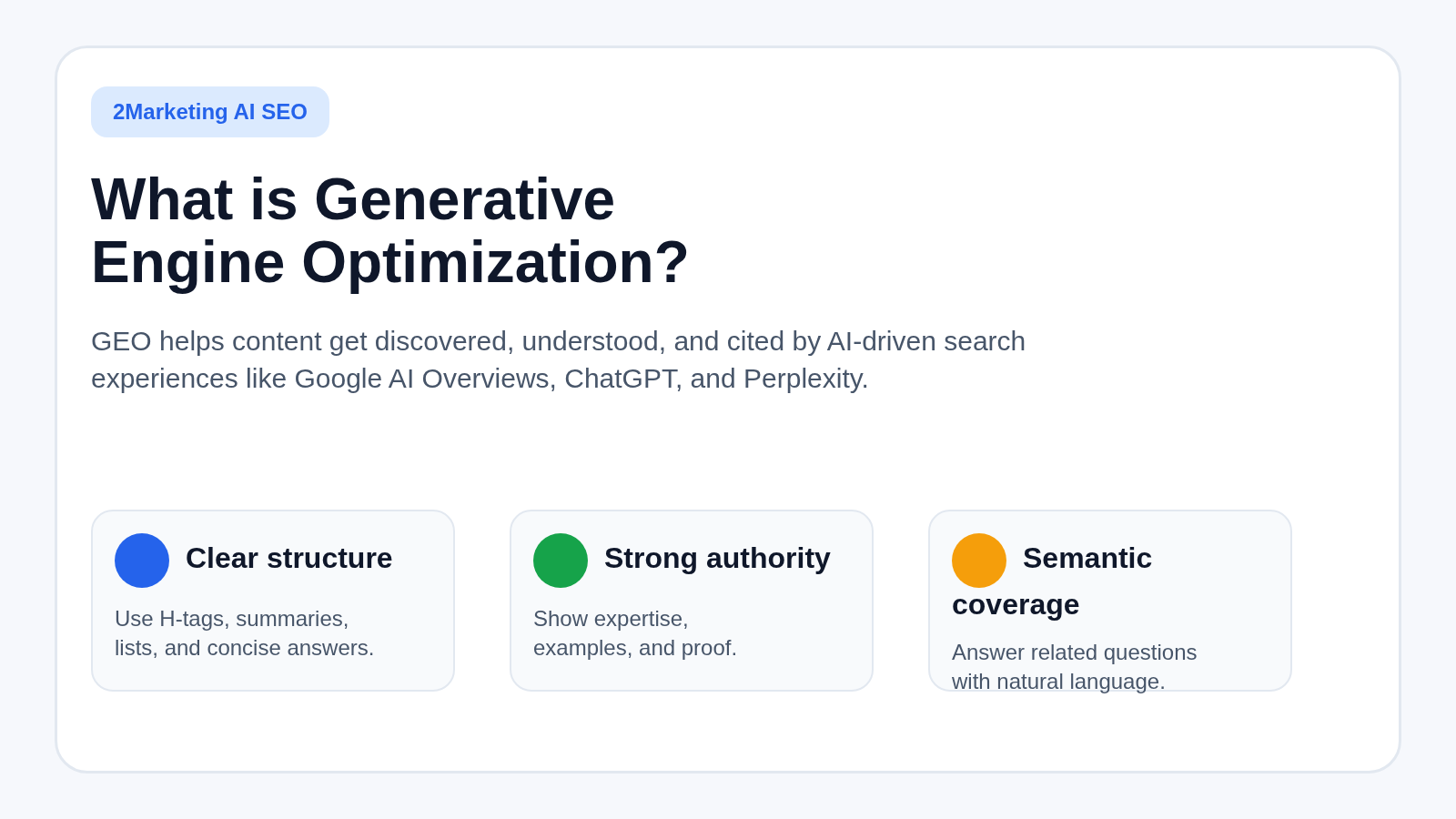
Key Aspects of GEO
- Goal: To become a cited or summarized source in AI-generated answers.
- Focus: Trustworthy, direct, context-rich content that aligns with search intent.
- Strategy: Use natural language, semantic coverage, structured formatting, and strong authority signals.
- Context: GEO extends SEO by optimizing for interpretation and synthesis, not just ranking position.
Table of Contents
- What is GEO?
- Why GEO matters now
- GEO vs SEO
- How AI-powered search engines interpret content
- Core pillars of GEO
- Relevant semantic and LSI terms
- How to optimize a page for GEO
- Common GEO mistakes
- FAQ
What Is Generative Engine Optimization?
Generative Engine Optimization is the process of creating and organizing content so generative search systems can parse it, understand its meaning, evaluate its reliability, and reuse it in a concise answer. That is the heart of it. The goal is not simply to appear in a search result page. The goal is to influence the answer layer.
That answer layer can appear in several places: Google AI Overviews, conversational engines such as ChatGPT and Perplexity, search assistants embedded into browsers, and increasingly inside productivity tools, voice interfaces, and shopping experiences. This matters because user behavior is changing. People are typing longer questions, using natural language, and expecting direct summaries rather than ten blue links and a lot of clicking around.
If you think about it, GEO is really a response to that behavior. Users ask: “What is GEO?” “How is GEO different from SEO?” “How do I optimize content for AI search?” The winning content is the page that answers clearly, supports its claims, organizes information logically, and anticipates follow-up questions without becoming bloated or vague.
There is a subtle difference between content that ranks and content that gets cited. Ranking often rewards domain strength, backlinks, internal linking, technical health, and relevance. Citation, on the other hand, also rewards clarity, extractability, definitional precision, topical completeness, and trust signals. A page can rank reasonably well and still be poor material for AI summarization. I have seen that pattern enough times that it no longer feels theoretical.
So GEO is not the death of SEO. It is more like SEO growing up and getting better at answer design.
Why GEO Matters in 2026 and Beyond
The rise of AI-generated search results changes the economics of visibility. In the old model, the main objective was simple: earn a click. In the new model, there are at least three objectives running at once:
- earn a ranking,
- earn inclusion in the AI summary,
- and earn trust quickly enough that the user still wants to click through.
That is a bit messy, yes, but that is what makes modern search interesting. The user might get a partial answer from an overview and then choose one or two cited sources to go deeper. If your brand is cited there, you gain authority even before the click. If your content is not structured for citation, you may still rank somewhere, but your visibility can shrink in practical terms.
For businesses in competitive markets, especially service businesses, this shift is too important to ignore. A strong SEO strategy now has to consider how content performs in AI-assisted search journeys. The same is true for content marketing. If you publish guides, explainers, pricing pages, service pages, or original research, GEO can improve how often your content is surfaced, summarized, or referenced when someone asks a high-intent question.
There is also a branding angle. AI models often compress a category into a few cited voices. That means fewer sources may receive more attention. In other words, GEO can create a winner-takes-more effect. Not always, perhaps, but often enough. Brands that publish clean, well-structured, high-trust content stand a better chance of being one of those few voices.
And then there is efficiency. Good GEO content tends to age well because it is built around definitions, semantic depth, FAQs, comparisons, examples, and evidence. Those assets also help with featured snippets, People Also Ask results, topical authority, and conversion-oriented blog traffic. So the upside is layered. You are not optimizing for one fragile tactic. You are building stronger content overall.
GEO vs. Traditional SEO
It helps to be blunt here: GEO and SEO are not enemies. GEO is not a replacement for technical SEO, crawlability, backlinks, site speed, internal linking, or information architecture. If your site is difficult to crawl, painfully slow, thin, or weak on authority, GEO will not magically rescue it. But GEO adds another optimization lens: how easily can an AI engine extract, trust, and reuse this content?
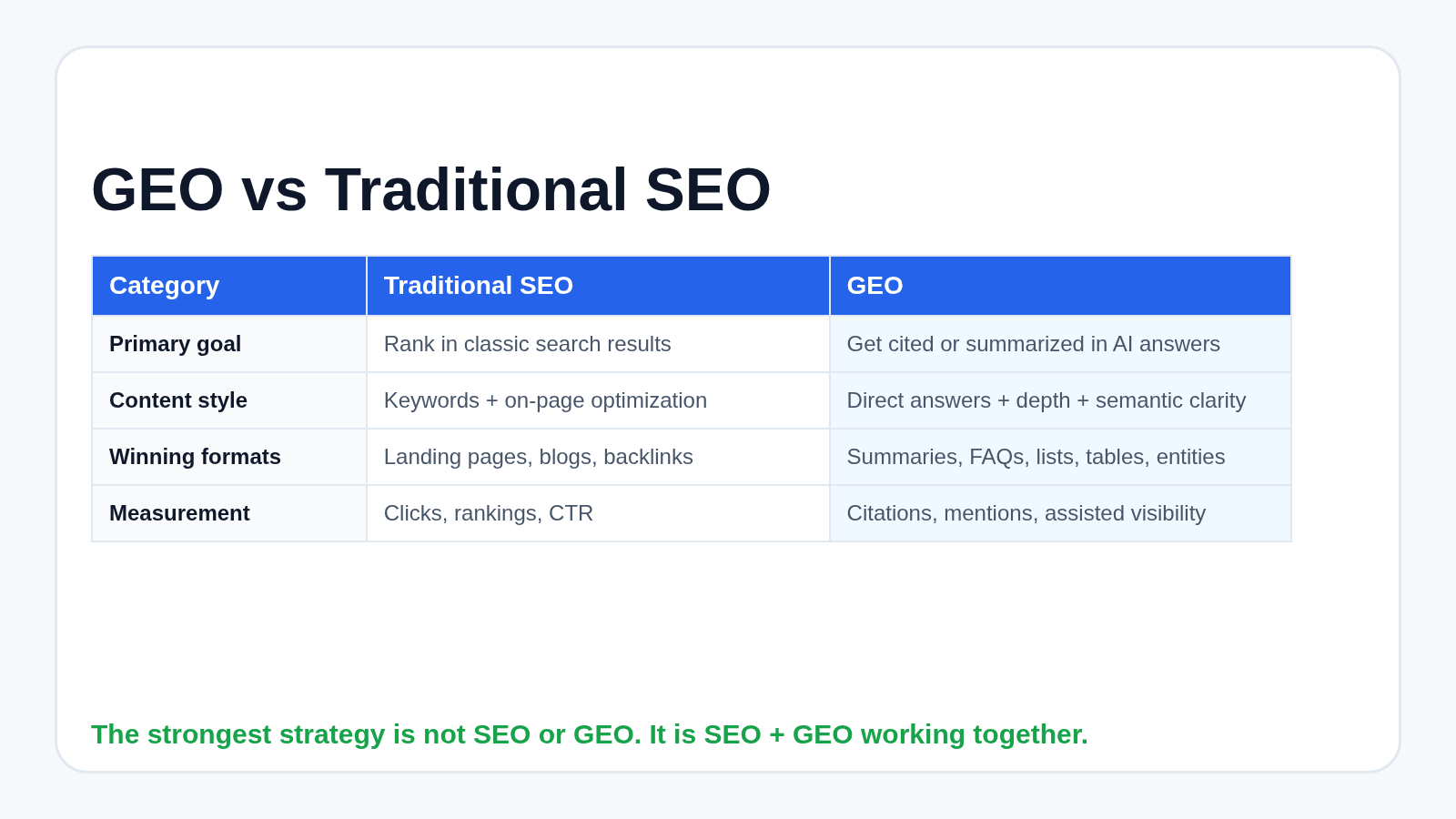
| Category | Traditional SEO | Generative Engine Optimization |
|---|---|---|
| Primary goal | Rank highly in organic search results | Become a trusted source in AI-generated answers |
| Query type | Often keyword-driven | Often conversational and intent-driven |
| Winning content | Optimized landing pages, blog posts, pillar pages | Pages with summaries, tables, FAQs, definitions, entities, examples |
| Measurement | Rankings, clicks, CTR, traffic | Mentions, citations, assisted visibility, downstream branded demand |
| Optimization emphasis | On-page SEO, backlinks, technical performance | Semantic clarity, answer quality, structure, authority, quotability |
SEO asks, “Can I rank?” GEO asks, “Can I be used as the answer?” The best content strategy now asks both questions at the same time.
How AI-Powered Search Engines Interpret Content
AI search systems do not read pages exactly like a human, though sometimes we lazily talk as if they do. They parse structure, detect entities, map concepts, compare passages, estimate relevance, and weigh signals of authority and clarity. They are looking for extractable meaning. That phrase sounds technical, but it is useful.
Extractable meaning usually comes from a few things:
- a clear definition near the top of the page,
- headings that mirror user questions,
- short answer blocks before deeper explanation,
- tables and lists that compress complexity,
- consistent terminology,
- evidence, examples, and links that support claims.
That is one reason a cluttered article often underperforms in AI environments. If the page rambles for 800 words before defining the topic, the system has to work harder. If the page answers vaguely, contradicts itself, or hides important information in fluff, it becomes less quotable. Humans dislike that too, honestly, but AI systems expose the weakness faster.
Semantic relationships matter as well. A strong GEO page on Generative Engine Optimization should naturally mention related concepts such as AI search, AI Overviews, answer engine optimization, semantic SEO, structured data, search intent, E-E-A-T, knowledge graphs, prompt-driven discovery, entity optimization, and content clustering. Not because a checklist says so, but because that is how the topic actually works.
If you are already familiar with digital marketing trends in 2026, you can probably see where this is heading. Search is becoming more interpretive, more conversational, and more compressed. Pages that remain shallow, generic, or formulaic will have a harder time standing out.
The Core Pillars of GEO
1. Clear, direct answers
Start by answering the primary question early. Do not make the user hunt for it. A concise opening definition often becomes the anchor that both users and AI systems rely on.
2. Topical depth
After the short answer, expand into related questions, edge cases, examples, comparisons, implementation steps, and common mistakes. Surface-level content rarely becomes a trusted reference.
3. Structural clarity
Use meaningful headings, bullets, numbered steps, tables, and summary sections. Structure is not decoration. It helps interpretation.
4. Authority and trust
Include specific observations, strategic nuance, real use cases, and internally linked context. A page with credible supporting pages tends to feel more trustworthy. If someone wants help implementing this in practice, a local AI SEO report can also strengthen that next step from awareness to action.
5. Context and semantic coverage
Use the natural language of the topic. Cover adjacent concepts without wandering off into irrelevance. A little discipline matters here. More words do not automatically mean more authority.
6. Technical accessibility
Fast load times, clean HTML, descriptive image alt text, correct schema, mobile usability, and sensible internal linking still matter. GEO is built on top of technical competence, not instead of it.
Relevant LSI and Semantic Keywords for GEO
There is a fair bit of debate around the phrase “LSI keywords,” and technically the term is used loosely in SEO circles. Still, the underlying idea remains useful: cover semantically related language that reflects how the topic is understood. For this article, the most relevant supporting terms include:
| Primary semantic terms | Supporting relevance terms | Intent modifiers |
|---|---|---|
| AI search optimization, answer engine optimization, generative search | semantic SEO, structured data, content clusters | what is GEO, how GEO works, GEO strategy |
| Google AI Overviews, ChatGPT search, Perplexity AI | source citation, entity optimization, answer visibility | GEO vs SEO, optimize for AI search, cited in AI results |
| E-E-A-T, trust signals, topical authority | question-based content, FAQ schema, article schema | best GEO practices, GEO checklist, AI content optimization |
Notice what is happening here. The goal is not to stuff these phrases awkwardly into every section. The goal is to reflect the real semantic neighborhood of the topic. That is a better way to think about optimization now.
How to Optimize Content for GEO: A Practical Framework
If you want content that performs well in both classic search and generative search, the workflow below is a good starting point.
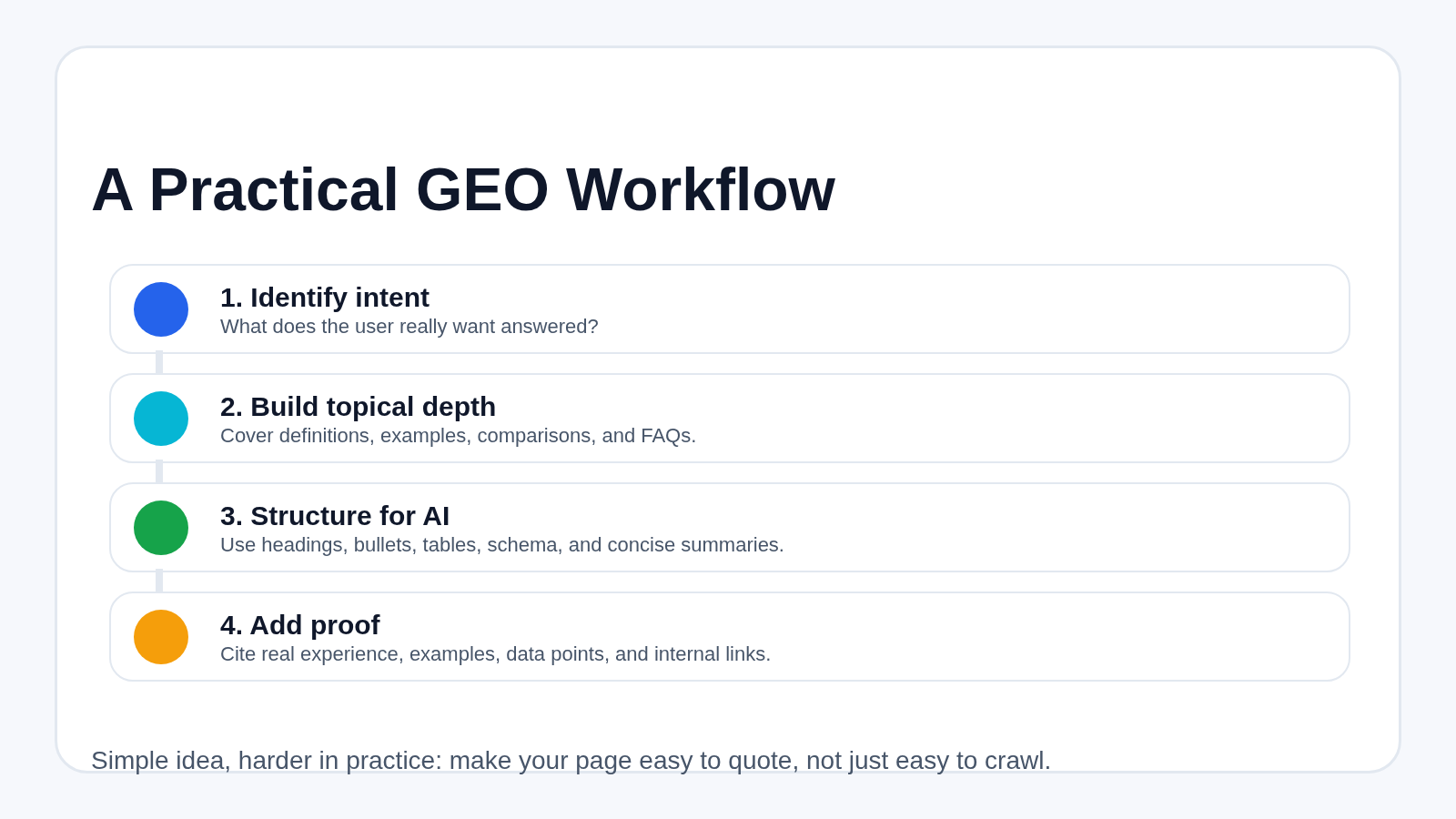
Step 1: Start with the exact intent
Every GEO page should know which question it is trying to own. Not vaguely address. Own. In this case the core query is “What is Generative Engine Optimization?” But the page also needs to support adjacent intent: why it matters, how it compares with SEO, how to implement it, and how to measure it.
Step 2: Write an extractable introduction
The opening should define the topic in one or two clean paragraphs, then briefly explain why it matters. If your introduction is sharp, it can serve as a summary for humans and as a citation-ready passage for AI engines.
Step 3: Organize content by question-led headings
Use H2 and H3 headings that reflect natural search behavior. Examples include:
- What is GEO?
- Why does GEO matter?
- How is GEO different from SEO?
- How do you optimize content for AI Overviews?
- What schema helps GEO?
These headings are useful because they mirror actual user prompts and give the page a predictable retrieval structure.
Step 4: Add summary blocks, lists, and tables
AI systems like information that can be segmented cleanly. Summary blocks help. Bullet points help. Comparison tables help even more when the user is evaluating options or concepts. A practical article should not be afraid of visual compression. Some writers avoid it because they think it feels simplistic. I tend to disagree. Good simplification is a sign of understanding.
Step 5: Build authority with specificity
Generic content is easy to generate and easy to ignore. Strong GEO content includes strategic nuance, examples, internal references, and enough detail that the page feels grounded. If your business already offers web design in Dubai or SEO strategy, for example, it makes sense to connect GEO to site architecture, landing-page clarity, and conversion-focused content design rather than discussing it as an abstract trend.
Step 6: Use internal linking with intent
Internal links are not just for crawling. They reinforce context and help search engines understand your topical relationships. In this article, relevant internal links point to services and resources that naturally extend the conversation, such as SEO cost in Dubai for buyers evaluating investment or your broader SEO agency service page for implementation support.
Step 7: Add schema where it actually helps
Schema does not create authority out of thin air, but it can clarify content type and support machine readability. For a guide like this, the most appropriate schema types are:
- Article or BlogPosting
- FAQPage if the FAQ section is visible on the page
- BreadcrumbList if your theme supports it
- Organization at the site level rather than stuffing it into each post unnecessarily
Step 8: Update, refine, and expand
GEO is not a one-time checklist. AI search behavior changes. SERP layouts change. Citation patterns change. Language changes too. A post on an evolving topic should be reviewed regularly, especially if it targets a high-value informational query.
What Makes Content More Likely to Be Cited by AI?
This question matters because ranking alone no longer explains visibility. A page becomes more citation-friendly when it includes:
- a direct definition near the top,
- factually consistent language,
- supporting sections that answer related questions,
- concise lists and comparison tables,
- clear bylines, brand context, or evidence of expertise,
- internal links that support topical authority,
- strong readability without becoming thin.
There is a style component too. Articles that read naturally but remain disciplined often perform better than content that sounds like it was engineered for a rubric. A little rhythm helps. A sentence can be short. The next can be longer and more reflective. Not every paragraph needs to land like a marketing slogan. Human-feeling clarity is still clarity.
Common GEO Mistakes to Avoid
| Mistake | Why it hurts | Better approach |
|---|---|---|
| Writing vague introductions | AI systems struggle to extract the main answer quickly | Define the topic clearly within the first two paragraphs |
| Chasing keywords without context | Content feels thin and unnatural | Use semantic depth and answer real follow-up questions |
| Ignoring structure | Poor readability and weak extractability | Use headings, bullets, tables, and summaries |
| Publishing generic AI-written copy | No differentiation, low trust, weak citations | Add insight, examples, brand expertise, and useful nuance |
| Forgetting internal links | Topical relationships remain weak | Link to relevant service pages, reports, and related articles |
How to Measure GEO Performance
Measurement is still evolving, which can be frustrating. It would be nice if there were one clean dashboard and a universal GEO score. There is not. Not yet. But you can still track meaningful indicators:
- organic impressions and clicks for question-based queries,
- changes in branded search after publishing strong thought-leadership content,
- referral traffic from AI search tools where available,
- featured snippet wins and People Also Ask appearances,
- engagement metrics on information-rich pages,
- assisted conversions from blog visitors who later convert through service pages.
Qualitative review matters too. Search the target question in AI-enabled experiences and observe which pages are cited, how the answer is framed, and what content formats keep appearing. If lists, definitions, and concise comparison blocks keep showing up, that is not an accident. It is a hint.
Who Should Care Most About GEO?
In theory, everyone who publishes content online. In practice, GEO matters most for:
- service businesses competing on expertise,
- SaaS companies educating buyers,
- publishers creating evergreen guides,
- local businesses building authority in competitive niches,
- agencies that rely on content to generate trust before the sales call.
For a digital agency, GEO is especially valuable because so many prospects begin with exploratory questions. They ask about SEO costs, AI SEO, website design, traffic growth, and local visibility before they are ready to submit a form. Informational content that answers those questions well can quietly move buyers forward. Maybe not dramatically in one visit. But over time, yes, very much so.
Is GEO Just Another Buzzword?
Partly, maybe. Marketing loves a new label. But the underlying shift is real. Search interfaces are changing. AI summaries are influencing discovery. Citation-friendly content is becoming more valuable. You can call that GEO, answer engine optimization, or AI search optimization. The name is less important than the behavior it describes.
That said, it would be a mistake to overreact and throw away proven SEO foundations. Some brands are doing that. They hear “AI search” and immediately produce thin FAQ pages, lifeless summaries, or auto-generated content that sounds polished but says almost nothing. That is not GEO. That is panic with formatting.
Frequently Asked Questions About GEO
What is Generative Engine Optimization in simple terms?
GEO is the practice of optimizing content so AI-powered search engines can understand it easily and cite it in generated answers.
How is GEO different from SEO?
SEO focuses on ranking in traditional search results, while GEO focuses on becoming a trusted source inside AI-generated answers and summaries.
Does GEO replace SEO?
No. GEO builds on SEO. You still need technical SEO, content quality, internal linking, and authority signals. GEO simply adds another optimization layer.
What content formats work best for GEO?
Guides, explainers, FAQs, definition-led posts, comparison pages, pricing pages, case studies, and pages with strong summaries, lists, and tables tend to work well.
What schema should I use for GEO?
Article or BlogPosting schema is appropriate for blog content, while FAQPage schema can help when the FAQ is visible on the page. Schema supports clarity, but it does not replace substance.
Can local businesses benefit from GEO?
Yes. Local service businesses can benefit significantly because AI-assisted search often summarizes provider options, services, pricing context, and expertise before users click through.
Final Thoughts: GEO Is About Being Useful Enough to Be Reused
That may be the simplest way to end this. Generative Engine Optimization is not about tricking AI systems. It is about making your content so clear, thorough, and trustworthy that reuse becomes the obvious choice. If a page is easy to understand, easy to quote, and genuinely useful, it has a better chance of showing up in the new answer-driven search landscape.
For brands that want stronger visibility across both Google and AI-powered discovery tools, the path forward is fairly clear, even if the exact platforms keep changing. Build topical authority. Answer real questions. Structure your content intelligently. Use schema where it helps. Support ideas with examples. Connect related content through meaningful internal links. Keep refining.
In the end, GEO is not really about gaming AI. It is about publishing the kind of page a smart system would be comfortable recommending to someone else. And, honestly, that is probably the kind of content we should have been aiming for all along.