
Last updated: April 4, 2026
Effective web design in Dubai requires mobile-first architecture, bilingual Arabic-English functionality, culturally relevant visuals, and fast load times tuned for UAE audiences. Professional projects typically range from AED 5,000 for basic sites to AED 80,000+ for custom enterprise builds, depending on scope, features, and the agency’s experience in the Dubai market.
Key Takeaways
- Mobile-first design is now the baseline requirement, not a bonus feature, for any Dubai website
- Bilingual Arabic/English UX with proper RTL layout directly affects credibility and conversion rates
- AI-driven personalization is now accessible to SMEs, not just large enterprises [1]
- Web design costs in Dubai range widely: AED 5,000 to AED 80,000+, depending on complexity
- Generic templates actively damage brand credibility in competitive sectors like real estate, healthcare, and fintech [1]
- Privacy compliance under UAE Federal Decree-Law No. 45 of 2021 is now legally mandatory [3]
- SEO and UX are now a single unified strategy, not separate disciplines [1]
- Dubai startups can compete effectively by prioritizing speed, accessibility, and niche-specific design
- Dark mode, scroll-based storytelling, and bold typography are the dominant visual trends for 2026 [3][4]
- Choosing the right agency matters more than choosing the right template
What Makes Web Design in Dubai Fundamentally Different?
Dubai’s digital market operates under conditions that most global web design playbooks simply don’t account for. The city’s audience is genuinely multilingual, the regulatory environment has tightened considerably, and user expectations are shaped by exposure to some of the most premium digital experiences in the world.
For any business targeting UAE consumers or B2B clients in the region, web design in Dubai isn’t just about aesthetics. It’s about building trust in a market where credibility signals matter enormously and where a poorly localized website can lose a prospect in under three seconds.
Three factors make Dubai’s web design context unique:
- Audience diversity: Dubai’s population is over 90% expatriate, meaning your website needs to speak to multiple cultural sensibilities simultaneously, not just one dominant demographic
- Bilingual expectations: Arabic is the official language and a legal requirement in many contexts; English is the business standard. A website that handles only one language, or handles both poorly, immediately signals a lack of investment [1]
- Premium market positioning: Dubai consumers and businesses are accustomed to high-quality digital experiences. A dated or generic website reads as a credibility problem, not just an aesthetic one
What Are the Top Web Design Trends for Dubai Businesses in 2026?
The most important trends for 2026 aren’t about decoration. They reflect real shifts in how users behave, how search engines rank pages, and what the UAE’s regulatory environment now requires.
Mobile-First Is No Longer Optional
Mobile traffic dominates across virtually every industry in the UAE. Modern web design in Dubai starts with the mobile layout and scales up to desktop, which is the reverse of how most legacy websites were built [1][2]. Ultra-fast mobile performance is also a direct ranking factor, so slow mobile sites lose on both UX and SEO simultaneously.
What this means practically:
- Design for a 390px viewport first, then expand
- Compress images aggressively without sacrificing visual quality
- Eliminate render-blocking scripts on mobile load paths
- Test on actual UAE network conditions, not just fiber speeds
Bilingual Arabic-English Design Determines Credibility
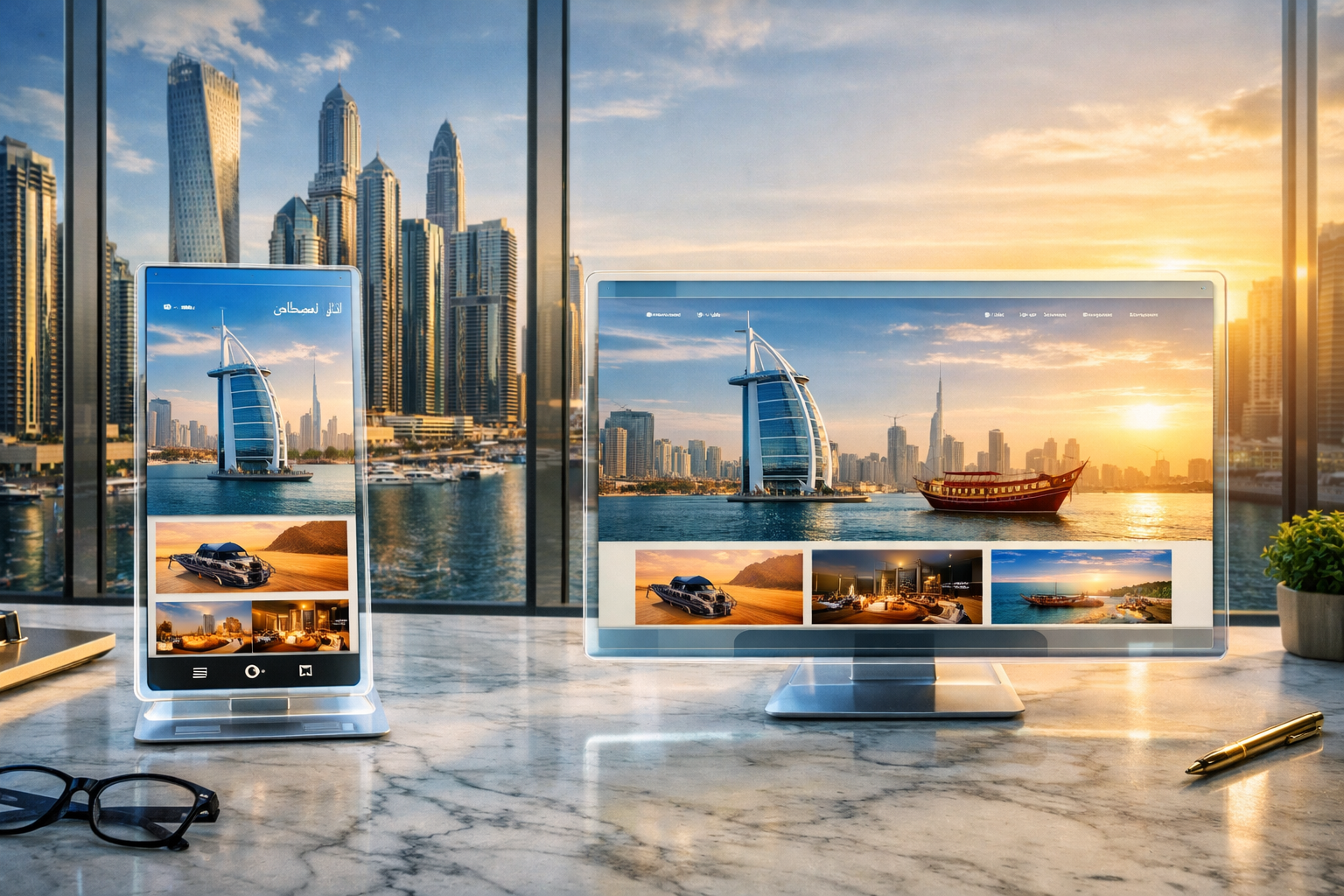
Websites that fail to implement Arabic RTL (Right-to-Left) layouts properly, or that treat Arabic as an afterthought translation layer, struggle with both usability and trust [1]. In 2026, proper bilingual UX means equal design quality in both languages, consistent branding across versions, and culturally sensitive messaging that doesn’t just translate words but adapts meaning.
“A bilingual website done poorly is worse than a monolingual one. It signals to Arabic-speaking users that their experience wasn’t worth the investment.” — A sentiment widely echoed by UAE UX practitioners
Scroll-Based Storytelling Is Replacing Static Layouts
The old priority of cramming everything above the fold is fading fast. Dubai websites in 2026 use full-page scroll sequences to guide users through a narrative, with animated elements, shifting backgrounds, and progressive content reveals that build toward a call-to-action [3]. This works particularly well for real estate, luxury brands, and professional services.
Bold Typography as a Visual Anchor
Graphic design in 2026 emphasizes contrast between oversized hero typography and ultra-clean layouts [4]. Brands are moving away from safe, predictable sans-serifs toward experimental letterforms and kinetic typography where text interacts with imagery. This is especially visible in Dubai’s luxury hospitality and fashion sectors.
Dark Mode, AI Personalization, and Accessibility
Dark mode has shifted from a user preference to a credibility and sustainability signal. Leading Dubai websites now default to dark mode on OLED screens to reduce energy consumption [3]. Meanwhile, AI-driven personalization, once reserved for enterprise budgets, is now accessible to SMEs and adapts content based on user behavior, location, and device type [1].
Accessibility has also moved from optional to essential. Proper contrast ratios, keyboard navigation, and screen-reader compatibility improve both user experience and SEO performance [1]. For businesses exploring the broader digital landscape, the latest digital marketing trends in Dubai for 2026 provide useful context on how design intersects with broader marketing strategy.
Privacy-First Design Is Legally Required
The UAE’s Personal Data Protection Law (Federal Decree-Law No. 45 of 2021) is now fully enforced. Dubai websites must handle personal data responsibly and communicate privacy practices clearly, including cookie consent, data storage disclosures, and user rights [3]. This isn’t just a European concern anymore.
How Much Does Professional Web Design Cost in Dubai?
Professional web design in Dubai ranges from approximately AED 5,000 for a basic brochure site to AED 80,000 or more for a fully custom enterprise platform. The variation is significant, and understanding what drives cost helps buyers make better decisions.
For a detailed breakdown, the web design cost guide for Dubai in 2026 covers pricing tiers, what’s typically included, and how to evaluate quotes from agencies.
Cost Tiers by Project Type
| Project Type | Estimated Cost (AED) | Typical Timeline |
|---|---|---|
| Basic brochure / landing page | 5,000 — 15,000 | 2–4 weeks |
| Small business website (5–10 pages) | 15,000 — 35,000 | 4–8 weeks |
| E-commerce (up to 500 products) | 30,000 — 60,000 | 8–16 weeks |
| Custom enterprise / portal | 60,000 — 150,000+ | 3–6 months |
| Real estate / property platform | 40,000 — 100,000+ | 3–5 months |
Note: These are estimates based on typical agency pricing in Dubai as of 2026. Actual costs vary based on agency size, feature complexity, integrations, and ongoing maintenance agreements.
What drives costs up:
- Custom Arabic RTL design (not just mirrored English)
- Third-party integrations (CRM, payment gateways, property listing APIs)
- Animation and interactive elements
- Ongoing SEO and content strategy built into the project
- Enterprise-grade security and hosting requirements
What keeps costs down:
- Using a proven CMS like WordPress or Webflow with a quality starter theme
- Providing complete content and assets before development begins
- Limiting revision rounds through clear upfront briefs
Common mistake: Choosing the cheapest quote without checking whether Arabic design is genuinely included or just auto-translated. This often results in a second rebuild within 12 months.
What Makes a Website Design Effective for Dubai’s Digital Market?
An effective Dubai website converts visitors into leads or customers. That sounds obvious, but many businesses in the UAE invest in visually impressive sites that perform poorly on the metrics that actually matter.
The core elements of an effective Dubai website:
- Speed: Pages should load in under 2.5 seconds on mobile. Every additional second of load time reduces conversion probability
- Clear information architecture: Users should find what they need in three clicks or fewer. This applies equally in Arabic and English navigation
- Trust signals: Client logos, certifications, case studies, and testimonials carry significant weight in Dubai’s relationship-driven business culture
- Localized CTAs: “Get a Free Consultation” performs differently than “Contact Us.” Test language that reflects how Dubai buyers actually make decisions
- Integrated SEO structure: URL structure, heading hierarchy, meta data, and internal linking should be planned at the design stage, not added afterward [1]
For businesses in specialized sectors, design requirements differ considerably. Healthcare websites, for example, must prioritize trust signals, clear service descriptions, and regulatory compliance. The approach used for healthcare digital marketing in Dubai illustrates how industry-specific design choices translate directly into patient acquisition outcomes.
Similarly, real estate platforms require immersive visuals, map integrations, and property filtering systems that generic templates simply cannot accommodate. A case study worth reviewing is the Totality Real Estate Dubai project, which demonstrates how custom design choices affect lead generation in a competitive property market.
Which Web Design Agencies in Dubai Have the Best Portfolios?
The honest answer is that “best portfolio” depends entirely on your industry and project type. A portfolio full of luxury hospitality websites tells you nothing about an agency’s ability to build a B2B SaaS platform or a healthcare portal.
What to look for when evaluating Dubai web design agencies:
- Industry-relevant work: Has the agency built sites in your sector? Generic portfolio breadth matters less than specific depth
- Bilingual execution quality: Review Arabic versions of their work, not just English. Poor RTL implementation is a red flag
- Performance data: Can they share load speed scores, conversion rate improvements, or organic traffic growth from past projects?
- Post-launch support: Many Dubai agencies excel at delivery but provide minimal ongoing support. Clarify maintenance, hosting, and update terms upfront
- Transparency on process: Agencies that can clearly explain their discovery, wireframing, and testing process tend to deliver more predictable results
For businesses wanting to see how a results-focused agency approaches web and digital projects, the 2Marketing case studies provide concrete examples across multiple industries including real estate, B2B, and e-commerce.
Decision rule: Choose an agency with at least two to three portfolio examples in your specific industry. If they can’t show relevant work, ask for references from similar clients before committing.
How Can Dubai Startups Create a Competitive Website Design?
Dubai startups can absolutely compete with established players online, but the approach needs to be strategic rather than aspirational. Trying to build a feature-rich enterprise site on a startup budget usually produces a mediocre version of everything rather than an excellent version of what actually matters.
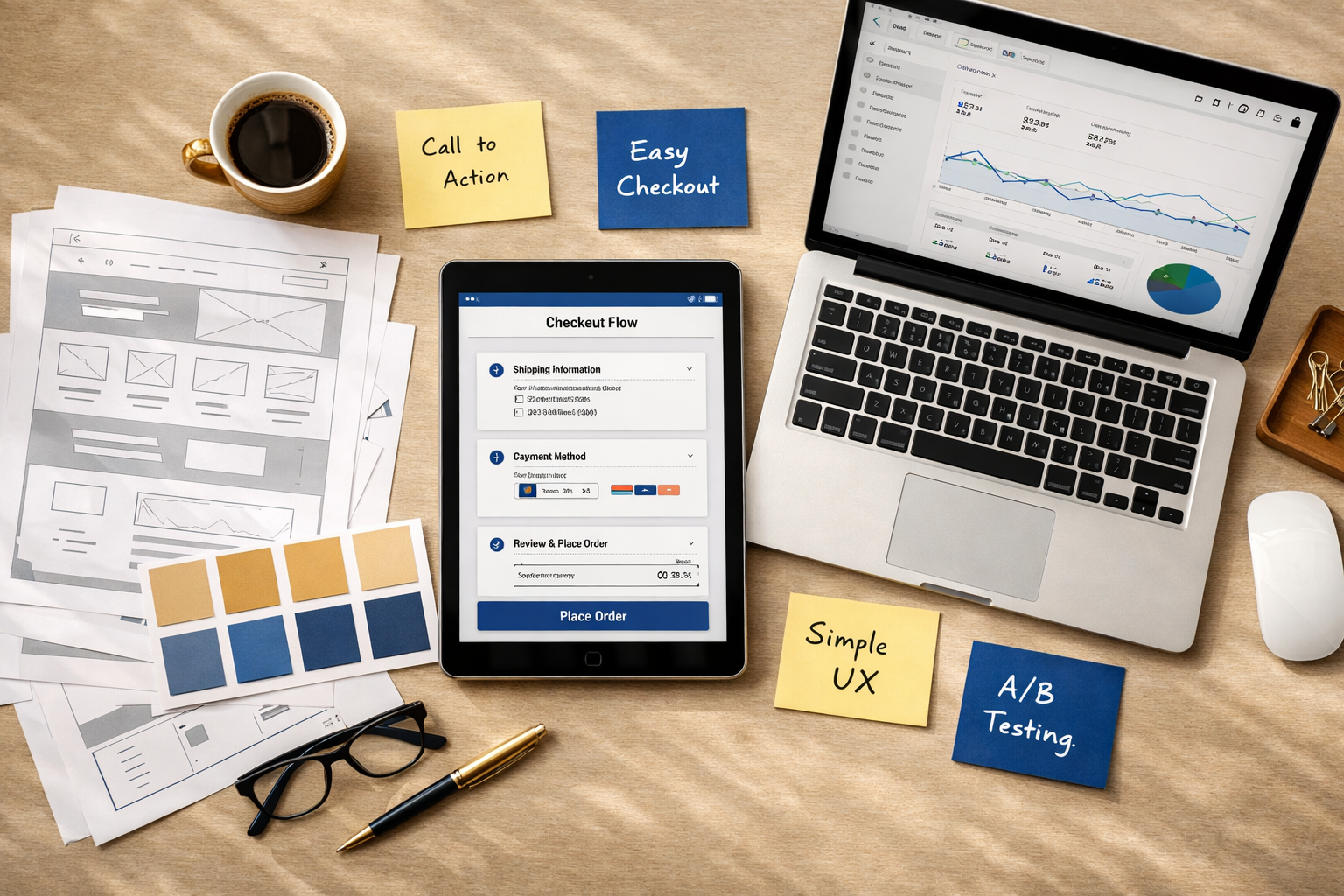
A practical framework for startup web design in Dubai:
Phase 1: Start lean, start fast
- Build a focused five to seven page site covering: home, services/product, about, case studies or social proof, and contact
- Use a quality CMS (WordPress, Webflow, or Shopify for e-commerce) with a premium theme adapted for Arabic/English
- Invest in professional photography or high-quality licensed imagery. Stock photos undermine credibility in Dubai’s premium market
Phase 2: Optimize before you expand
- Connect Google Search Console and Analytics from day one
- Set up conversion tracking for every CTA, not just contact form submissions
- Run usability tests with real users from your target audience, including Arabic speakers if relevant
Phase 3: Build on what works
- Add features based on actual user behavior data, not assumptions
- Expand content strategically around search terms your audience uses
- Consider whether paid search or SEO is the right growth lever at your current stage. The SEO cost guide for Dubai in 2026 helps startups understand what organic growth realistically requires
What startups get wrong most often:
- Over-investing in visual complexity before validating the core value proposition
- Skipping Arabic design entirely to save budget, then losing a significant portion of potential customers
- Treating the website as a one-time project rather than an evolving asset
For startups in specialized sectors like dental or medical services, the design requirements are even more specific. The digital marketing approach for dentists in Dubai shows how niche-specific design and content strategy work together.
How Do SEO and Web Design Work Together in Dubai?
SEO and web design are no longer separate disciplines. Search engines now reward clear information architecture, fast loading times, and strong engagement metrics, which means design decisions directly influence search rankings [1].
Design choices that affect SEO performance:
- Core Web Vitals: Largest Contentful Paint (LCP), Cumulative Layout Shift (CLS), and Interaction to Next Paint (INP) are ranking signals. Poor design execution creates poor scores
- Heading structure: H1 through H3 hierarchy communicates page structure to search engines. Many Dubai websites use headings purely for visual styling, which confuses crawlers
- Internal linking: A well-designed navigation and contextual link structure distributes authority across the site and helps search engines understand content relationships
- Mobile usability: Google’s mobile-first indexing means the mobile version of your site is the primary version for ranking purposes [2]
For businesses serious about organic growth, understanding how professional SEO services in Dubai integrate with web design from the project’s start, rather than being bolted on afterward, is worth the conversation before any design brief is written.
There’s also an emerging layer worth understanding: Generative Engine Optimization (GEO), which concerns how AI-powered search systems surface and cite web content. The GEO guide for 2026 explains how this affects content and design decisions for businesses that want visibility in AI-driven search results.
What Are the Most Common Web Design Mistakes Dubai Businesses Make?
Even well-funded Dubai businesses make predictable mistakes that undermine their digital investment. Knowing these in advance is genuinely useful.
The most common and costly mistakes:
Treating Arabic as an afterthought: Auto-translating English content and mirroring the layout is not bilingual design. It’s a shortcut that Arabic-speaking users notice immediately [1]
Ignoring page speed: Dubai businesses often approve visually heavy designs without testing load times. A beautiful site that takes six seconds to load on mobile loses most of its audience before they see the content [2]
Generic templates in competitive sectors: In real estate, healthcare, and professional services, template-based sites signal low investment to sophisticated buyers [1]. Industry-specific customization isn’t a luxury; it’s a competitive requirement
No clear conversion path: Many Dubai websites are designed as digital brochures rather than lead generation tools. Every page should have a logical next step for the visitor
Skipping accessibility: Beyond the ethical dimension, inaccessible websites perform worse in SEO and exclude a meaningful portion of potential customers [1]
Neglecting post-launch: A website launched without a content update plan, security monitoring, or performance tracking deteriorates quickly in both rankings and user experience
Misaligned agency selection: Choosing an agency based on price or aesthetics alone, without verifying their technical capability in Arabic design, SEO integration, and your specific industry, is the root cause of most failed Dubai web projects
FAQ: Web Design in Dubai
Q: How long does it take to build a professional website in Dubai? A: A basic five to eight page business site typically takes four to eight weeks. E-commerce platforms and custom portals run eight to twenty weeks depending on complexity and how quickly the client provides content and approvals.
Q: Is WordPress still a good choice for Dubai businesses in 2026? A: Yes, for most small to mid-sized businesses. WordPress handles Arabic RTL well with the right theme and plugins, integrates with most third-party tools, and has a strong local developer community in Dubai. Webflow is a strong alternative for design-heavy projects.
Q: Do I need a separate Arabic website or can one site handle both languages? A: One site with a language switcher is the standard approach and preferred for SEO. It keeps domain authority consolidated. The key is that both language versions must be fully designed, not just translated, and the RTL switch must affect layout, not just text direction.
Q: What is the UAE Personal Data Protection Law and how does it affect my website? A: Federal Decree-Law No. 45 of 2021 governs how personal data is collected, stored, and processed in the UAE. For websites, this means clear cookie consent mechanisms, a compliant privacy policy, and transparent data handling practices. Non-compliance carries legal risk [3].
Q: Can a Dubai startup compete with established brands online through web design alone? A: Web design is one factor. A fast, credible, well-structured site levels the playing field, but it needs to be paired with SEO, content, and potentially paid traffic to generate consistent leads. Design is the foundation, not the complete strategy.
Q: What is the difference between web design and web development in Dubai? A: Web design covers the visual and UX layer: layout, typography, color, user flows, and wireframes. Web development is the technical build: coding, database management, integrations, and performance optimization. Many Dubai agencies offer both; smaller studios often specialize in one.
Q: How important is hosting for a Dubai-based website? A: Very. Hosting servers located in or near the UAE reduce latency for local users and can improve rankings in UAE-specific search results. A UAE or GCC-region server is worth the marginal cost difference for businesses primarily targeting the local market.
Q: Should I use a local Dubai agency or an international one? A: Local agencies understand Arabic design requirements, UAE regulatory context, and the cultural nuances of the market. International agencies may have stronger technical capabilities for complex platforms but often lack bilingual design expertise. For most Dubai businesses, a local or regionally focused agency is the better starting point.
Q: What is GEO and why does it matter for my Dubai website in 2026? A: Generative Engine Optimization (GEO) is the practice of structuring content so that AI-powered search engines (like Google’s AI Overviews or ChatGPT search) surface and cite your website. As AI-driven search grows in the UAE market, this is becoming a meaningful traffic source alongside traditional SEO.
Q: How do I measure whether my website redesign was successful? A: Track organic traffic growth, conversion rate (leads or sales per visitor), average session duration, bounce rate, and Core Web Vitals scores before and after the redesign. A successful redesign should improve most of these metrics within three to six months.
Conclusion: Building a Website That Actually Works in Dubai
Web design in Dubai in 2026 is not a creative exercise. It’s a strategic business investment that, when executed correctly, generates measurable returns through better search visibility, higher conversion rates, and stronger brand credibility in one of the world’s most competitive digital markets.
The businesses that get this right share a few common traits. They treat bilingual design as a core requirement rather than a budget line to cut. They build for mobile performance first. They choose agencies with verifiable experience in their specific industry. And they plan for ongoing optimization rather than treating launch day as the finish line.
Actionable next steps:
- Audit your current site against the criteria in this guide: mobile speed, Arabic UX quality, accessibility, and conversion path clarity
- Define your project scope before approaching agencies. Know whether you need a brochure site, an e-commerce platform, or a lead generation machine
- Request industry-specific portfolio examples from any agency you consider, and review their Arabic work specifically
- Understand the full cost picture including hosting, maintenance, and SEO, not just the design and build fee. The web design cost guide for Dubai is a useful reference
- Integrate SEO from day one. Talk to your agency about URL structure, heading hierarchy, and Core Web Vitals before a single wireframe is drawn
- Plan for GEO. As AI-driven search grows, content structure and citation-worthiness matter more than ever
For businesses ready to move forward, 2Marketing’s web design services in Dubai offer a starting point for understanding what a results-focused approach looks like in practice. And if organic visibility is a priority, a free local AI SEO report can surface quick wins before a full redesign begins.
The Dubai market rewards quality. A website that’s fast, bilingual, credible, and built for conversion isn’t just good design. It’s a competitive advantage.
References
[1] Modern Website Design Trends For UAE Businesses In 2026 – https://www.fajri.com/modern-website-design-trends-for-uae-businesses-in-2026/
[2] Web Design Trends – https://viacondigital.ae/web-design-trends/
[3] Web Design Trends Dubai 2026 – https://uaewebdesigner.com/blog/web-design-trends-dubai-2026/
[4] Design Trends – https://svyazi-agency.ae/blog/design-trends